Pests
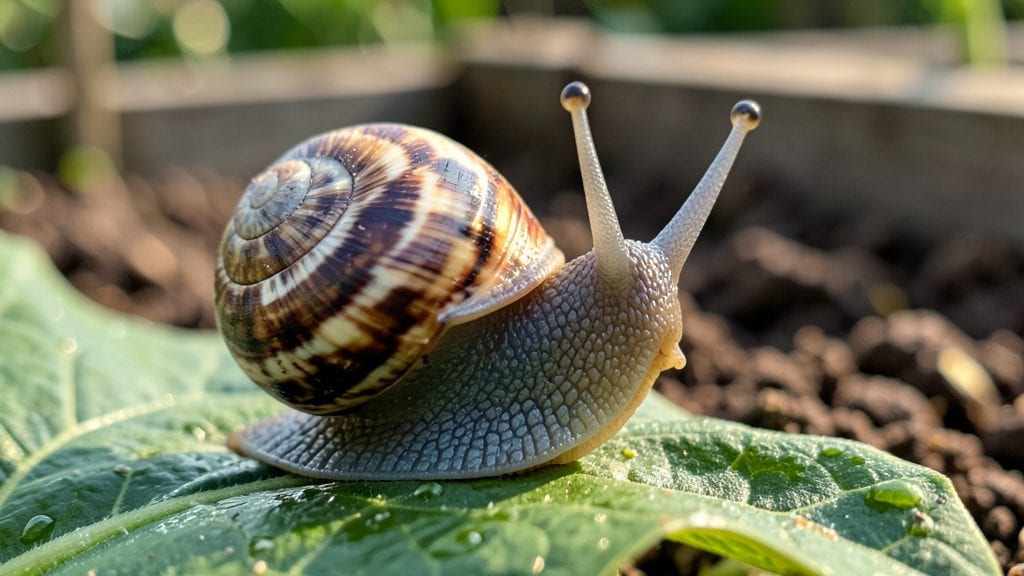
Understanding garden snail anatomy reveals their soft, coiled-shell bodies, retractable heads with sensory tentacles, and slippery mucus trails—key adaptations that let them thrive in moist environments while conserving water and navigating obstacles.
Their coiled shells aren't just for show—they're fortified with calcium-rich layers that protect their delicate bodies while also helping regulate moisture loss. 🔥 The two pairs of tentacles (longer for vision, shorter for smell) act like built-in sensors, detecting food sources and predators from a safe distance.
Meanwhile, that slimy mucus trail serves dual purposes: it creates a water barrier to prevent dehydration and leaves a chemical trail they follow like a map.
What's fascinating is how their muscular foot works—it expands and contracts like a wave, propelling them forward while their shell stays anchored. This combination of features explains why they're so resilient in gardens: their anatomy turns every damp corner into a survival advantage.
💡 In This Article
- How Garden Snail Body Parts Function Together
- Identifying Garden Snails by Key Physical Traits
How garden snail body parts function together
The coiled shell serves as a mobile fortress, protecting the snail's soft body while also functioning as a water reservoir. Made of calcium carbonate layers, the shell can weigh up to 50% of the snail's total body weight in some species, providing both structural support and moisture regulation.
During dry periods, the snail can seal its shell opening with a thin layer of mucus to prevent dehydration—a survival trick that lets them survive weeks without water. 🔥
The two pairs of tentacles are their built-in sensory network: the longer upper pair (ocular tentacles) contain 1,000+ photoreceptors that detect light and movement, while the shorter lower pair (olfactory tentacles) sample air currents for chemical cues like food or predators.
When threatened, these tentacles retract instantly, pulling the head into the shell within 0.3 seconds. This rapid response system explains why garden snails seem to vanish when you approach—it's not just hiding, it's an automatic survival reflex.
Movement relies on the muscular foot, which operates like a hydraulic system. The snail's foot contains 100,000+ cilia that create ripples, while specialized muscles generate forward motion at speeds up to 0.03 mph—slow but perfectly efficient for their low-energy lifestyle.
The foot's underside secretes mucus from glands that produce 1-2 milliliters per hour, creating a lubricated path that also contains antimicrobial compounds to prevent infections from abrasive surfaces.
Breathing occurs through a specialized lung-like structure called the pneumostome, located near the shell's opening. This system allows them to extract oxygen from air while minimizing water loss—a critical adaptation for terrestrial life.
During reproduction, the same anatomical features play starring roles: the foot becomes a muscular anchor during mating, while the mucus trail helps locate partners through chemical signals spread over up to 3 feet of garden space.
What's often overlooked is how these systems work in harmony. The shell's calcium content comes from their diet, while the foot's mucus contains enzymes that break down plant matter—meaning their anatomy directly supports their herbivorous lifestyle.
Even their slow movement is an adaptation: conserving energy in a world where predators lurk and food is scattered makes their anatomy a masterclass in efficient design. ✨
Their respiratory system is particularly fascinating—while most land snails have a single lung, garden snails possess a pseudo-lung that functions like a gill when submerged, allowing them to survive brief floods. This dual capability explains why you'll find them active after rain: their anatomy bridges aquatic and terrestrial life perfectly.
The mucus also contains glycoproteins that help them adhere to surfaces, creating a temporary waterproof barrier that prevents dehydration during their slow, deliberate journeys through gardens.